Meet tightening stormwater rules - on the buildings you already have.
SmartFlow helps owners, developers and municipalities meet source-control and overflow obligations on existing buildings, without reconstruction - with automatic per-storm reports that document exactly what each roof retained and released.
Why compliance is changing
Across the EU, the Gulf and beyond, regulators are moving the burden of stormwater to the source - the plot and the building - and asking owners to prove it. New buildings can design this in; existing buildings need a retrofit. SmartFlow turns any flat roof existing drainage outlet into a controlled, measured and documented retention point.
What the rules require, by region
European Union
The revised Urban Wastewater Treatment Directive (EU) 2024/3019 entered into force in 2025; member states transpose it into national law by 31 July 2027.
- Larger cities must establish integrated urban wastewater management plans that prioritise green and blue infrastructure and rainwater retention at source.
- An indicative objective keeps stormwater overflows to no more than 2% of the annual collected load for larger agglomerations, with 2039 and 2045 milestones.
- Owners increasingly need to show how runoff is retained and released - not just that a system exists.
United Kingdom
Sustainable Drainage Systems (SuDS) are required for major developments through national planning policy, and DEFRA published updated National Standards for SuDS in 2025. (Schedule 3 of the Flood and Water Management Act 2010 is in force in Wales; in England SuDS are delivered through planning policy.)
- Developments must control peak surface-water runoff towards greenfield runoff rates, with climate-change allowances.
- On previously developed (brownfield) sites a relaxation factor applies where greenfield rates cannot be met - attenuation on the building is often the practical answer.
- SmartFlow adds controlled rooftop attenuation and per-storm records on existing buildings, without reconstruction.
United States
Under the EPA NPDES MS4 program, municipalities require post-construction stormwater control. Many use a retention benchmark based on the 90th-percentile storm, and redevelopment standards often require retaining a set depth (for example 0.8 inch) from impervious area.
- Requirements vary by municipality - cities such as Washington DC, Philadelphia and Seattle have strong on-site retention mandates.
- The rules allow retrofits and on-site retention or detention as a compliance path, including where on-grade controls are infeasible.
- SmartFlow turns the existing roof outlet into measured, documented on-site detention.
Australia
Most councils require On-Site Stormwater Detention (OSD) under Water Sensitive Urban Design (WSUD) - temporary storage with controlled release to a permissible site-discharge rate. OSD has been standard across the Sydney region since the 1990s.
- OSD must store runoff and release it slowly, typically clearing within about two hours after rain.
- Discharge limits are set per council; rooftop attenuation can deliver OSD without below-ground tanks.
- SmartFlow provides controlled rooftop detention and per-storm reports on existing flat roofs.
United Arab Emirates (Dubai)
The Dubai Municipality Stormwater Design Guidelines require on-site attenuation, and a No Objection Certificate (NOC) must be obtained before construction.
- Projects above set plot thresholds must provide on-site attenuation or retention.
- SmartFlow per-storm retention and release reports support the NOC as an on-site attenuation measure.
- Hardware on the drainage outlet, with no vegetation, suits hot, arid climates where green roofs are impractical.
Every installation streams to a cloud dashboard visible to both the consultant or planner and the municipality, with real-time status and an automatic report for every storm.
- Automatic per-storm compliance reports - what each roof retained and released, documented.
- A shared dashboard for the planner and the municipality, with real-time status.
- Forecast-aware control that frees capacity before the next storm and can hold water on a city signal.
- Add-on unit for every 110/160 mm drain: pressure sensor, built-in cellular, manual override, open by default (fail-safe).
Two ways to comply
Hardware-only retrofit
The Add-on mounts on the existing roof outlet - no structural changes, no vegetation. Ideal where green roofs are impractical, including hot, arid climates.
Holistic blue-green roof
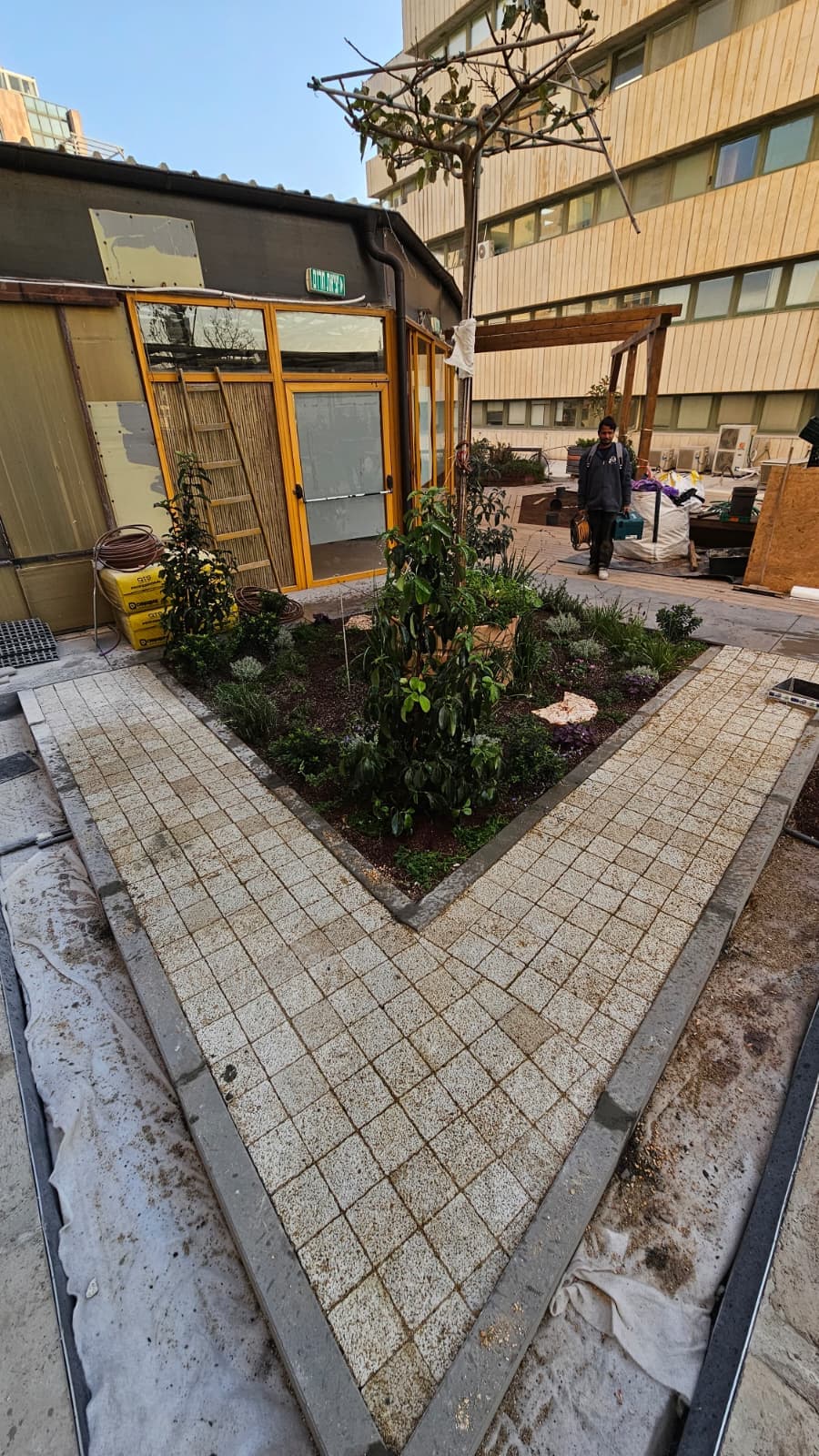
Where vegetation is wanted or required, SmartFlow can deliver a blue-green roof and integrate with irrigation controllers under the same smart control - meeting the green-infrastructure preference in the EU and other frameworks.
Where municipal roof policy is heading
Emerging municipal roof policies target specific building types: commercial and employment buildings with roofs over 250 sqm, building additions over 100 sqm, new and renovated public buildings, and urban renewal districts. Installing today means being ahead of tomorrow’s requirement, at a marginal cost compared to underground infrastructure.
Passive restriction vs. SmartFlow
Static flow restrictors and unmanaged retention can reduce peak flow, but they cannot see a storm coming, cannot prove what they did, and cannot coordinate with the city. SmartFlow does all three - on the existing roof outlet.
Peak discharge reduction of 30-50% is based on SmartFlow active installations. The comparison reflects general passive approaches, not any specific product.
Regulations set the objective - retention at source and fewer overflows. SmartFlow helps owners meet that objective on existing buildings; it does not replace project-specific engineering or local approvals.
Stormwater compliance FAQ
Does SmartFlow help meet stormwater regulations on existing buildings?
Yes. SmartFlow adds controlled rooftop retention to the existing drainage outlet, helping owners meet source-control and peak-flow obligations on buildings that were never designed for them - without reconstruction.
How does SmartFlow document compliance?
Every storm is logged automatically. SmartFlow generates per-storm reports showing exactly how much each roof retained and released, providing the evidence regulators and authorities ask for.
Is SmartFlow itself a legal requirement?
No. Regulations set an objective - for example a maximum discharge rate. SmartFlow is a tool that helps you meet that objective and prove it; it is not a mandate in itself.
Talk to us about compliance on your portfolio.
Tell us where your buildings are and which rules apply - we will show how SmartFlow documents compliance, storm by storm.