An integrated system for rooftop stormwater control
Hardware, software, and control logic designed to work as a single system — installed on existing rooftops, managed from the cloud.

Solar Impulse
Efficient Solution Label
Technion
Peer-reviewed research foundation
17+
Active deployments in Israel
~30%
Peak-flow reduction - field-measured
Three layers. One system.
SmartFlow combines a physical device, a cloud platform, and a control layer — each designed to operate reliably in real-world conditions.
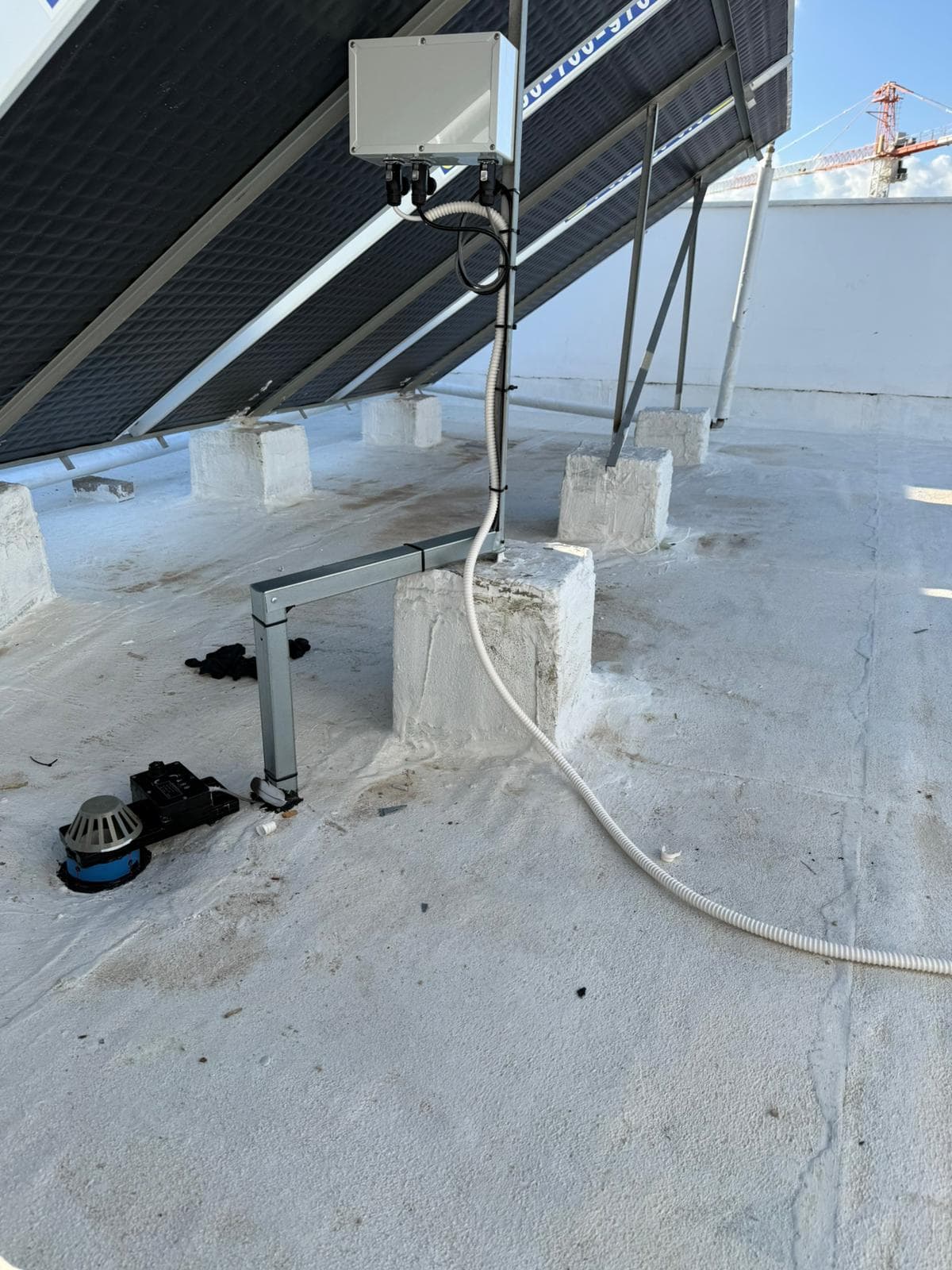
Smart Roof Device
Installed on existing drainage outlet. Monitors water level, controls roof valve, communicates with cloud.
Cloud Platform
Receives telemetry, serves dashboards, manages configuration and alerts across all sites.
Adaptive Control
Evaluates sensor state and weather forecasts to determine roof valve commands within defined safety limits.
Drain Add-on Unit
A compact unit that mounts on any existing drain — 110 or 160 mm — self-installed in up to 15 minutes without touching the waterproofing. All it needs is a nearby power socket.
- Sealed enclosure for outdoor rooftop environments
- Motorized roof valve with position feedback
- 4G/LTE cellular connectivity
- On-device manual override for maintenance

| Actuator | Motorized roof valve with position feedback |
| Water level sensor | Ultrasonic, ±5 mm accuracy |
| Connectivity | 4G/LTE cellular |
| Enclosure rating | IP67 |
| Manual override | On-device switch |
| Operating temp | -10°C to +60°C |
| Installation | Surface-mount, no drainage modification |
Cloud Monitoring Platform
A web-based interface for portfolio-level monitoring, configuration, and reporting. Accessible from desktop and mobile without specialist software.


Adaptive Control Logic
The control algorithm operates continuously — evaluating sensor data and weather forecasts to determine when and how much to release, within defined safety constraints.
- 1Weather forecast data ingested from meteorological APIs
- 2Rooftop water level monitored continuously by on-device sensor
- 3Control algorithm evaluates current state against configured release profile
- 4Roof valve command issued - open, close, or partial position
- 5Action logged with timestamp, sensor state, and weather context

Normally open by design
In failure scenarios, the system prioritizes safe drainage over retention. In the event of connectivity loss, sensor fault, or power failure, the roof valve returns to its default open state and raises an alert to the control platform.
Designed for continuous operation
Rooftop environments are demanding. SmartFlow is designed for long-term outdoor deployment with minimal maintenance intervention.
Failure modes
In failure scenarios, the system prioritizes safe drainage over retention:
Connectivity loss
Device continues local control. The roof valve returns to its default open state and an alert is raised to the control platform.
Sensor fault
The roof valve returns to its default open state. An alert is raised immediately. Drainage is never compromised.
Power failure
The roof valve returns to its default open state - safe drainage is ensured in all conditions.
Engineering benefits
Active hydraulic flow control reduces peak loads on municipal drainage systems during heavy rainfall. In some projects, this can reduce the number of drains required, allow smaller-diameter piping, and lower installation costs. Controlled release also reduces flood risk from sudden peak flows, and, by managing on-roof water levels, reduces exposure to basement-level pipe leakage from drainage overload.
- Reduced peak loads on municipal drainage systems during heavy rainfall
- Fewer drains and smaller-diameter piping possible in some projects
- Lower installation costs where drain count and pipe sizing are reduced
- Lower flood risk from sudden peak flows through controlled release
- Reduced exposure to basement-level pipe leakage from drainage overload
The real question isn’t "active versus passive"
It’s: how much additional effective storage do you get per 1,000 m² of roof, without expanding the building footprint or adding underground infrastructure? SmartFlow is engineered to retain an on-roof water depth of 2 to 18 cm, set by the hydrological requirement and the specific roof’s structural rating - up to 180 m³ of effective retention per 1,000 m², with no added storage layer, no infiltration pit, and no underground tank. In dense urban sites, every cubic meter of storage that does not need separate underground infrastructure has direct cost value to the developer.
Retention depths are engineering design targets, engineered per project and subject to structural verification per building.
Learn how the platform enables smart stormwater management at the building level, or see our Acre Residential Neighborhood case study.
Discover blue roof technology or read about stormwater systems for buildings.
Passive restriction vs. SmartFlow
Static flow restrictors and unmanaged retention can reduce peak flow, but they cannot see a storm coming, cannot prove what they did, and cannot coordinate with the city. SmartFlow does all three - on the existing roof outlet.
Peak discharge reduction of 30-50% is based on SmartFlow active installations. The comparison reflects general passive approaches, not any specific product.
Ready to assess your rooftop?
Contact our engineering team to discuss your building or portfolio. We will provide a clear picture of installation requirements and expected performance.